Sunday, September 30, 2012

Adult Education

Adult are grown-up people. Adult education means educating those adults who are not educated. In some countries, there is little need for adult education because education is compulsory and everybody id educated. In some countries, there is need for adult education because the majority of the people are uneducated because education is not compulsory in our country.

Our country cannot advance until the majority of the adults are educated. It is the adults who form the working class. If they are not educated they cannot understand the problems of the country. They cannot study and understand the development plans. We cannot expect them to co-operate in such plans when they do not understand them. uneducated people can be exploited by selfish persons. They are conservative and believe in superstitions and traditional methods. They do not know the changes that have taken place in the world. They are slow to move with the times.

Nepal is country of peasants. The prosperity of our country are illiterate and ignorant. They follow the traditional methods of agriculture. They do not use improved methods of cultivation and new types of seeds and manure. They cannot market their products at a good profit.

Female Education

Female education means the education of women. A mation consists of men and women. A nation cannot rise if women are not educated. Women form nearly half of the population of a country. If women are not educated, half of the population is uneducated. A nation with half of its population uneducated a cannot achieve any remarkable progress. Men and women are move on one wheel. In the same way, a nation can march to progress if both its men and women are educated.

Female education has been neglected in our country since the earliest days. We find some isolated cases of educated women in the history of our land. But the majority of women were steeped in ignorance and illiteracy. Homes wee considered to be the field  of work for women.

Women were forbidden to go out and work in other fields of activity. This idea has slowly changed among the educated people, But the mass of the still harbour this idea. We find some educated women in towns, But the village women are still uneducated.

Saturday, September 15, 2012

Roads

The people of a place cannot  live in isolation. They have to remain in touch with the people of  other places foa various reasons. Roads are the means of travelling  from one place to another. Man has been building roads since the earliest days. In ancient times good roads were few and far between. Now-a-days, we have many good roads. Some countries have more roads than others. There are many good roads in advanced countries. But only a few in less advanced country. Our country has only a few good roads, so out country is undeveloped.

There are two kinds of roads: metalled and non-metalled. Metalled roads were first built by Macadam in England in the 18th century, so they are also called macadanised roads. They are built of stone chips and coal-tar. Metalled roads motorable. They are less liable to wear and tear.

Roads are very useful to us. They develop trade. If we have good roads, we can send things that we produce in excess and bring thing that we do not produce or produce in small quantities. Roads also help the growth of industries. If we have good roads, We can bring men, materials and machines for our industries and send the products to other places.

Friday, September 14, 2012

Nepal

The world contains big and small countries. Nepal is a small country. It lies between China and India. It is nearly 500 miles long and 100 miles broad. The population of our country is fifteen million. Most if the people live in the velleys and the plains.

Nepal is the land of the Himalayas. The major portion of the Himalayas lies in our country. It contains some of the highest peaks, such as Everest, Dhaulagiri, Makalu, Lhotse and Annapurna. To the south to the Terai. The there is a narrow plain called the Terai. The chief rivers of our country are the Kosi, the Gandaki and the Karnali.

The climate is cold in the north and hot in the south. The  Himalayan region gets very cold in winter.  The Terai is very hot on summer. The monsoon blowing from the Bay of Bengal brings rain in summer. The rainfall is good in all  parts of the country, but it decreases as we go from the east to the west.

Agriculture is the main occupation of the people. It is carried on mainly in the
Terai and the valleys. The Terai  produces rice, jute, sugarcane, oil-seeds etc. The valleys produce maize, pulses, bean, fruits etc.The high mountains are snow-covered; the hills are forested. Sheep and goats are reared on the hill- sides. Our country is poor in minerals. But the lack of minerals has been comoensated by hydro-electric power.
Nepal is a secular state. The people enjoy freedom if religion. There are different religious classes, the major ones being the Hindus and the Buddhists. Some people are Muslims. There is a small number of Christians, Sikhs and Jains.                                                                                                                                                        

Buddhist Culture-2

The birth place of lord Buddha (lumbini)

According to a legend, Ashoka erected five commemorative stupas in the city of Patan and sixth one at Kirtipur.And also the large number of indian people follow the way of buddhism and as a brotherhood,thses two countries follow the path shown by the Gautam Buddha.There are also several holy places in Nepal and India where people can have medication and worship buddhism.
The history of Buddhism in Nepal is linked with the origin of Swayambhu. Swayambhu purana,the sanskrit manuscript of fourteenth century,accounts the origin of the Swayambhu Mahachaitya.According to to its mythology,the dawn of civilization is the Kathmandu Valley, which is linked with the origin of Swayambhu Mahachaitya.

Innumerable monlithic caityas with polished stone made niches of the licchavi period testify the fact that Mahayana Buddhism was practised by the common people in the valley as their culture stupas are the embodiments of Dharmakaya or Buddha mind. The Tibetans call it as chorten. Stupa architecture consists of a spherical dome, a cubical steeple known as hermika, a spire of thirteen discs or stepping blocks in diminishing sizes.

Monday, September 10, 2012

Seasons-2


People indulge in feasting and merrymaking. They are free from the scorching heat of the summer season. It is a happy season, it lasts only two months.After the autumn, we have the winter season. It begins in November and lasts till February. It is a season of hardship. It is a cold season. It gets colder and colder as we proceed northwards. People have to wrap themslves with warm clothes. It is a hard time for the poor people. It is diffcult for them to go out for work. there is snowfall on the hills. This is also a busy season, for people are engaged in agriculture. Wheat, barley,oil-seeds, pulses and fruits are grown in this season.

Slowly, the winter season makes room for the spring. The spring, like the autmn, is a mild season. It season. It lasts two months March and April. the spring is considered the king of season. It is a fine season with mild sun-shine. there is no rainfall in this season. Plants and forth new buds and leaves. the green leaves delight our eyes and fill our minds with joy. It is also a seasonof plenty. the winter crops are reaped in this season.

Thursday, September 6, 2012

The Durbar Square


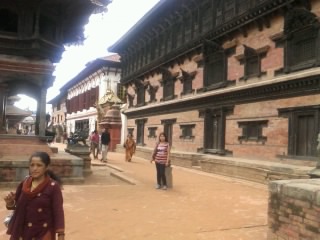
Near the gallery, we can see the Durbar (palace) where the Malla Kings lived. This palace was built by king Bhupatindra Malla. This palace contains fifty-five windows. These wooden windows are artistic and of old design. Besides this main palace, there ate other palaces in the big compound. We saw bullet marks onte walls and windows of some of these palaces. These bullet marks were laft in a battle fought between King Ranjit Malls of Bhaktapur and prithvi Narayan shah. Ranhit Malla fought bravely but was defeated.

Next we visited the ancient temples. First we visited the temple of Taleju Bhavani in the Durbar Square. Then we went to the Nyatapola temple. It has five storeys. It is the highest and most famous temple in the town. It occupies a central position in the town. We all so visited the temple of Dattatraya.This temple, they say, is made of the wood of a single tree. It is partly dilapidated.

A poem

As the world lies sleeping
I look out my window and watch.
And watch the silence
That once was life bustling.

Creeping are the shadows
That stretch across the land.

My face is pressed against the pane
Barely seen -but there.

So- as quietness shatters the earth
I count the many footprints in the sand, on the pavement, in life.


Monday, September 3, 2012

Nursing Service & Education in Nepal

Nursing Service:

1947 B.S., Bir Hospital was established with 15 bedded. 2007 B.S. Teku Hospital was established.
2016 B.S.Paropakar Shree Panch Indre Rajya Laxmi Devi Prasuti Ghrah, Thapathali-239 bedded now.
2019 B.S. Poush 22 Kantichildren Hospital. 1959 UMN- Patan Hospital and nursing college.
2040 B.S. (TUTH) Tribhuvan University Teaching Hospital Maharajgunuj only O.P.D.
2041 B.S. TUTH I.P.D.(indoor was establishe) 1956-2040 B.S.Total staff nurses 590.
Dr. Uma Devi and Miss Rukminicharan Shrestha were sent for staff nurse 2009 B.S.

Nursing Education :

The first school of nursing of nursing was opened in 2013 B.S. U.M.N. school of nursing was opened in 1959. 1956-1960 A.D. most enrolled student was S.L.C. fail. A condition was unmarried, widow and remains unmarried during their course. 1969 Requirement of entrance changed to S.L.C. pass.
1962 A.N.M. school was opend at Bharatpur for 18 month course.

Sunday, September 2, 2012

Losar

Tibetan New Year, known as Losar, is celebrated this month with vigor and earnestness both in the mine and monasteries by all Tibetan Buddhists. Like the Western New Year, It is a time of starting anew, and not merely with lifty resolutions but with a clean house, new clothes, and offerings and prayers to the lamas and deities.

The New Year begins on February 7, but preparations start two days before, a new moon day. Households are scrubbed clean and new furnishings installed. Family members bathe and spruce up as well. And from the second day of Losar, the real celebration begins. Friends and famikies gather in day long feast eating specially made cookies called khabje, meats fruits and various other delicacies; drinks if fermented rice or miller chhang, and distilled raksi are served in abundance.

In the olden times, it was customary for each adult sibling to host the entire family on consecutive days. Thus , large famikies might have celebrated Losar for ten or more days. Today, work demands usually shorten the festivities to several days.

The Sherpa and Tibetan Buddhists of the Kathmandu valley continue the Losar tradition with a commmunity wide gathering at the Sherpa Community center in Boudanath. On the third or fourth day of the new year.


The Holy Bathing of Seto Machhendranath

God seto Machhendranath is widely worshippded by hindu and Buddhist devotees of the Kathmandu valley who belive that he bestows the priceless gift of longevity. Especially upon children, and removes the cause of sterility in women; he is also called the God of pity and the Ocean of Compassion.

A festival commemmorating the holy bathing ceremony of seto Machhendranath is held at Kathmandu's Kel Tol temple at this time for a full week every year. The God's annual holy bath is a multiplw blesing, providing devotees the opportunity to deck his idol in splendid new robes and
allowing one and all another chance to celebrate.

According to legend, creation of the Seto Machhendranath image was commissioned by King Gunakamadev in the 9th century. It was later carride away by an invading king who, finding the image too burdensome, abandonde it in the Gandaki river between Kathmandu and pokhara. For the king's misdeed, he and his descendants of six generations were effected with horrible skin diseases. Finally having traced the cause of the illness, the royal family had the idol rescude from the fiver, secretly returned to its Kathmandu home, and buried in the mud near Rani Pokhari.

It was not until the reign of King Yaksha Malla in the 13th century that a Jyapu (valley farmer) discovered the image while gathering mud for his pots, and once again Seto Machhendranath assumed a prominent position in Kathmandu's religious life.

History of Nursing

Nursing is very young profesional in Nepal, Which was started only in 1926 (B.S. 1985) by sending four girls in Lucknow, India for midwifery training. The nursing education in Nepal was started in 1956.

At the beginning this nursing education programme was three & half year duration which included midewifery. His Majesty's Government of Nepal, Ministry of Health after 1972. This programme was taken over by Tribhuvan University and the duration of the course is changed into three years for certificate level.

The Nurse

Nurse is a person, who practices towars positive health. Nurse is a person who provodes total care of the sick, injured, wounded and dying person.

Introduction to Nursing:

Nursing is the care which puts a person in the best possible condition for nature t restore or preserve health, to prevent or to care diseased or sick person.

Qualities of a good nurse:

1. Self discipline
2. Honesty & Friendly
3. A caring attitude- love empathy.
4. Well balanced,Courage confidence,Intelligent & Physically and mentally healthy.
5. Punctual and good observer, sense of responsibility.

Scope of Nursing:

1. Hospital service/ Health planning.
2. Community health service/ N.G.O./ G.O. other projects.
3. International nursing.
4. Research and evaluation/ Private practice

Nursing in Nepal:

Before 2007(1950 A.D.)Nepal was isolated from the outside world. Bir sumsher established Bir-Hospital one doctor, two compounder and two Dressers. Then Bir sumsher also established other hospital at Birgnj. There were informal nursing services in Royal and Rana's families as ayas and dhaies.


Monday, August 27, 2012

THE DURGA PUJA

We nave many festivals in our country. The Durga puja is the greatest of our festivals. We call it Dashain. It is observed in the month of Aswin. It is celebrated earlist days. It is celebrated for a fortnight. It is festival of the Hindus only. This festival had its origin in the earliest days.

Goddess Durga is worship in this festival. She is worshipped for nine days. This period is called Navaratri (nine nights). The last two days are considered more important than the preceding days. During the Navaratri people worship the image of Dunga at home. They also visit temples of the goddess. Durga is considered shakti (power). She signifies the victory of good over Evil. There is a legend theat she killed Mahisaur, the wicked demon. People worship the goddess and seek her blessings. They sacrifice birds and animals and make other offerings.

During the Navaratri, people indulge in merry making and feasting. They clean their houses and put on new clothes. Many people eat meat and sweet dish. They kill birds and animals. Rich people kill the goats, sheep,boars etc. poor people kill birds like hens, ducks and buffaloes. People take rest from their work and pass the time in merry-making. Schools campuses offices and business concerns remain closed this festival.

Friday, August 24, 2012

THE HIMALAYAS-1

Nepal is known as the land of the Himalayas. There are the loftiest mountains in the world. The Himalayas extend all over Nothern Nepal and occupy nearly forty percent of the total land of our country. They consist of several parallel ranges, one higher then the other. The higher Himalayas are perpetually covered with snow, that's why they are called the Himalayas in sanskrit. Himalayas means the abode of snow. The higher Himalayas contain most of the highest peaks in the world. Some of the highest peaks are Mt.Everest Kanchenjunga, Lhotse and cho oyu. These peaks attract climbers every year. The high Himalayas contain several big glaciers and lakes. They are devoid of vegetation and human settlement.

The lower Himalayas are forested. The forests contain pine trees and rhododendrons.the rhoddendron is the national flower of our country. On the lower parts of these mountains we find valleys and lakes. The lower Himalayas are inhabited but the density of population is low. Life is difficult on the mountains. People rear goats and sheep. Some cultivation is done on the hill-slopes and in the valleys.

The Himalayas are a great hindrance to the development of our country. They cover a large part of our country. As they are unfit for cultivation, a big area of our country is a huge waste. Transport is difficult across the mountains and people cannot easily travel from one part of our country to another . Some parts of the Himalayas are inaccessible and inhospitable.

VILLAGE DEVELOPMENT

In every country, we find towns as well as villages. Some countries have more towns than villagers, while some countries have more villages than towns. In our country, we have more than towns. The majority of our people live in villages. There are more then 5000 villages on our country. So the development of our village is very important. The prosperity of our country depends upon the prosperity of our villages.

Our villages are in a wretched condition. They are full of dirt and filth. There os shortage of clean drinking water. The roads are not good. School and hospitals are few and far between. The villagers are illiterate. They do not know the laws of health. They suffer from cholera and other epidemic diseases. The main occupation of the villagers is farming. They are unacquainted withe the modern methods of cultivation. They do not use improved seeds and fetilizers. They do not have irrigational facilities. They remain out of work for many months. They do not have subidiary occupations. The villagers are poor. They can hardly make both ends meet.

We have to do many things to improve the condition of our villages. Roads should be built so that people may travel easily from one place to another. There should be schools for the village children. Literacy classes should be opened for the adults. There should be libraries and reading rooms. Hospitals and health posts should be set up. Clean drinking water should be supplied. The villages should be kept clean. The villagers should be taught the laws of health. There should irrigational facilities. Improved seeds and fertilizers should be made available.

Thursday, August 23, 2012

TECHNICAL EDUCATION

Technical education refers to the education which teaches one the use of machines, It teachers one the practical use of machines. Engineering, agriculture, weaving, carpentry cone under technical education. Technical education teaches us not only theory but also practice. It trains not only the brain but also the hand. Technical education is the reverse of academic education. Academic education gives us knowledge but it has no practical application. One who has receivad technical education is called a technician. A technician can make, use of repair a machine. For example, a pilot can drive an aeroplane; an engineer can repair a machine; a carpenter can make furniture.

Technical education helps the progress of a country. Technicians can build factories, roads, bridges, canals etc. They can drive trucks, trains, ships and aeroplanes. They can help to work mines and produce electricety. They can help to make use of forests. They can help the growth of agriculture and the production of raw materials. They can operate telephones and wireless sets technicians can help in every sphere of a nation's productive activities. Technical education helps a nation to be self-sufficient. If we do not have our own technicians, we have to bring them from other countries. If other countries do not help us we cannot develop our industries and agriculture. If we bring technicians from abroad,we have to pay them a lot of money. Now-a- days, we are undertaking many development projects in our country, but we lack technicians. So many plans and projects have been postponed or there has been very slow progress.

Technical education helps to solve the problem of unemployment. There is a great demand fir technicians in our trades,

SOCIAL SERVICE

Social service means serving society. It means helping people in trouble .It implies helping the needy and the distressed. It is voluntary service. In rendering social service, we do not expect anything in return. Suppose there is a man who has been run over by a motor-car. We take him to the hospital for treatment. This is an example of social service.

We live in society and need the help of others. It is out duty to serve society in return. If we serve others will serve us Social service has been extolled by all religions. It has been practised in all countries. Good men render social service, while bad men shun it. It is a means of repaping our debt to society.

Social service has various forms. Rich persons can render it by spending money. they can build schools, hospital and orphanages. Poor people can serve society by doing manual labour. they can help in cinstructing roads, digging drains, building dams, cleaning streets and executing community projects. Educated persons can serve society by teaching and instructing the illiterate persons. Social service can he rendered in various ways.

Social service is a double blessing. It blesses one that gives and one takes. The receiver is benefitted directly. The giver also is benefitted indirectly. He wins the live and respect of society. He may be helped by others when he is a spirit of sympathy and co-operation.

Social service may be rendered individually or collectively. There are some associations for social service. In our country we have the paro-pakar Association, the Marwari Seva Samiti. the Nepal boy and Girl scout Association. The Red Cross Society is a famous intermational association. We find such philanthropic associations in every country. Sometimes, temporary societies are formed when there are sudden calamities like earthquakes floods. etc.

Social service is very necessary in our country. The people of our country ate poor and illiterate. They require the guidance and assistance of others in many matters. we should all help those who are in need and distress. We should all help those who are in need and distress. Some members of our society lice in comfort, while others lice in misery. The fortunate members should render some help to the unfortunate ones to express their gratitude for the carious comforts they enjoy.

Tuesday, August 21, 2012

The Hospital

Our country has shortage of hospitals. We have hospitals in towns but our villages are still without hospitals. Hospitals are not held in high esteem in our country. Some persons still do not like to go to a hospital for treatment. They would rather die at home than be admitted into a hospital. This is sheer prejudice and ignorance.

A hospital has two departments indoor and outdoor. In the indoor department, patients are kept in wards and treated in the hospital. This department has two wards: patients are treated freely; in the private ward, they have to pay for the bed and medicinec, but they have to pay for the bed and medicinec, vut they receive the free service of doctors and nurses. Rich persons like to stay in the private ward . In the outdoor department patients are examined and adviced treatment at home . Simple cases are examined in the outdoor department, while major cases are treared in the indoor department.

A big hospital is a huge establishment. There are two wards: medical and surgical. there are many doctorrs, nurses and other workers.
all their acticities have to be suoervised and co-ordinated. Various kinds if medicines, equipments and materials have to be stored. There is an emergency ward.Cases of emergency have to be treated promptly. Patients have to be looked after carefully. Carelessness and neglect may result in suffering and death.A medical college lege should the immediately eatablished in our country. This will solve the problem of the shortage of doctors to some extent.

The hospitl is a very useful institution. Poor persons receive free treatment poor persons receive free treatment. In surgical and and serious medical cases even rich persons find it adcantageous to be treated in a hospital. In a facilities, Patients are carefully treated and nuresed. They are kept under strict medical rules. At home patients do not have such facilities.


In the weatern countries people go to a hospital even for minor cases because the hospitals are well-equipped and well-organised. In our country, even the few existing hospitals are poorly equipped and ill-staffed. They are generally short of medical supplies and facilities.People have little faith in our hospitals and doctors. Those who can afford, go to India and other ciuntries for treatment. This state of affairs should be improcved. Hospitals involve the question of life and death. The patients should be well-treated and carefully looked after.

Our villages are short of hospitals and medical facilities. Many villagers die for want of treatment. It is time that we give serious thought to the establishment of hospitals in villages. We cannot have a hospital for every village of panchayat, but we should establish hospitals at important rural centres. A hospital sat an important rural centre can serve the neighbouting villages. We should also turn turn our attention to the shortage of doctors.


Monday, August 20, 2012

A HISTORICAL PLACE

We most be familiar with the history of our country. One of the cest ways of learning history is to visit historical places. There are many historical places in our country. They are found in the Valley of Kathmandu and outside. I have visited few historical places outside the valley. I have visited many such places in the valley.
One of the famous historical places in the Valley of Kathmandu is Bhaktapur. It is a very old town. It was founded by king Ananda Dev in 1203 V.S. It was once a flourishing town. It was the capital of the Malla Kings. We travelled from Kathmandu by bus. It takes half an hour to reach there. There is a fine motorable road . The bus stopped near siddha pokhari. It is a big pond, but properly maintained.

We went to the Durbar Square and visited the National Art Gallery. The Gallery contains many historical pictures of the Malla Kings. It has a great educational value for students. It is a small gallery but well-maintained.